You have a formulation ready for encapsulation. It could be a free-flowing powder that behaves beautifully in a hopper. It could be a sticky herbal extract that clings to every surface. Or it could be delicately coated pellets that must not be crushed.
The machine you choose must do more than reach a certain speed. It must handle your specific material without excessive weight variation, without frequent jams, and without damaging the product. Yet many buyers select a capsule filling machine based primarily on output rate—then discover that their powder bridges, their pellets break, or their fill weight RSD exceeds acceptable limits.
This article explains how intermittent and continuous rotary motion affects fill accuracy for different material types. You will learn which architecture handles free-flowing powders, cohesive powders, granules, and pellets—and how to match motion to your formulation.
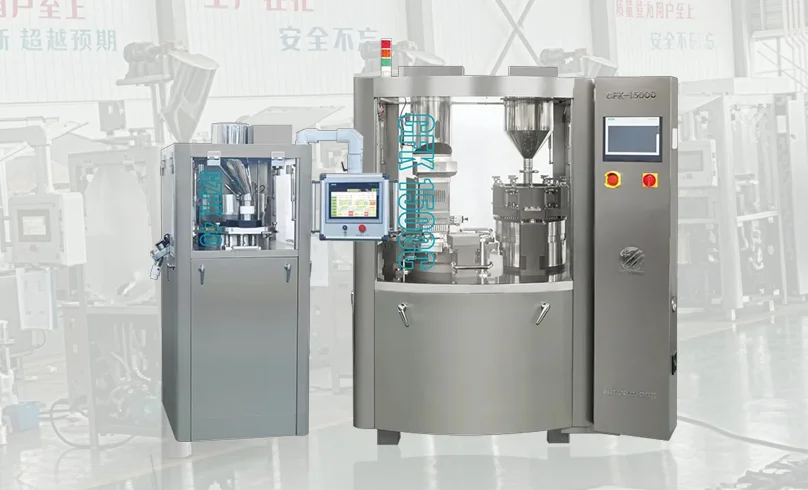
The terms describe how the capsule turret moves during the filling cycle—and this movement fundamentally affects how material enters the capsule.
The turret rotates in discrete steps, stops, performs filling operations, then rotates again. Motion pattern: Move → stop → fill → move → stop → fill.
What this means for material handling: The filling station sees a stationary turret during dosing. Dosing pins or tamping pins can dwell inside the powder bed for a controlled, adjustable duration. For materials that need time to flow, settle, or be drawn into a dosing chamber, this pause is critical.
The turret rotates without stopping. Filling occurs during motion, with dosing systems synchronized to move with the turret. Motion pattern: Continuous rotation, filling components moving in sync.
What this means for material handling: The fill window is fixed by rotational speed. At 200,000+ capsules/hour, available fill time per capsule may be only 50–100 milliseconds. Materials must flow, and dose within that brief window—or fill weight consistency suffers.
AAPS perspective: A technical reference from the American Association of Pharmaceutical Scientists notes that “the transition from intermittent to continuous rotary designs in capsule filling has been driven primarily by speed demands, though each architecture presents distinct advantages in fill accuracy mechanics at lower speeds”.
The table below compares how intermittent and continuous rotary machines perform across four material categories. Note that material behavior is the primary differentiator—not speed alone.
| Material Type | Intermittent Rotary | Continuous Rotary |
|---|---|---|
| Free-flowing powders (angle of repose < 35°) | Excellent (±1–2% RSD typical) | Very good (±2–3% RSD at high speed) |
| Cohesive / poor-flow powders (angle of repose > 40°) | Good—adjustable dwell time allows powder to settle | Challenging—fixed fill window may cause weight variation |
| Granules | Very good—granules flow well and can be dosed accurately | Good—if granule size distribution is narrow |
| Pellets / microtablets | Variable—precision depends on dosing mechanism | Variable—requires specialized pellet dosing systems |
The core insight: Intermittent machines excel with difficult-to-handle materials because they can pause longer at the fill station. Continuous machines excel with well-behaved, consistent materials run at high volume.
Examples: Lactose, microcrystalline cellulose, many direct-compression blends.
Best motion: Either architecture can work well.
Free-flowing powders are forgiving. They flow readily into dosing chambers regardless of whether the turret is moving or stopped. Continuous rotary machines can achieve ±2–3% fill weight RSD at high speeds. Intermittent machines may achieve slightly better (±1–2%), but the difference is often negligible for most applications.
Decision factor: Batch size and changeover frequency, not material behavior.
Examples: Fine herbal extracts, hygroscopic powders, APIs without sufficient glidants.
Best motion: Intermittent rotary.
These powders do not flow easily. They may bridge in the hopper, segregate, or require time to settle into a dosing chamber. Intermittent machines allow adjustable dwell time—the turret can pause longer at the fill station, giving the powder more time to flow into the dosing pins or tamping cavity.
A continuous machine forces filling to complete within a fixed angular window—regardless of how the powder behaves. If the powder is slow to flow, fill weights will vary.
Practical guidance: If your powder has a Carr's index above 25% or requires vibration assistance to flow, prioritize intermittent rotary.
Examples: Wet-granulated or dry-granulated formulations with uniform particle size.
Best motion: Either—depends on granule quality.
Granules generally flow better than powders and are less prone to bridging. Both architectures can handle granules effectively if the granule size distribution is controlled.
Caution: Granules with excessive fines (small particles) behave more like poor-flow powders. If your granulation produces significant fines, intermittent motion may provide more consistent results.
Examples: Coated multiparticulate systems, controlled-release pellets, enteric-coated beads.
Best motion: Depends on dosing mechanism—not simply intermittent vs continuous.
Pellets present a unique challenge. Unlike powders that can be compressed into a uniform plug, pellets are discrete particles that cannot be compacted without damage.
Patent literature notes that dosing units used for powders “are used to good advantage to precisely dose pharmaceutical material in powder form, whereas, if the capsules have to be filled with particulate material such as microtablets or micropellets, dosing is not equally precise”.
Some continuous rotary machines are specifically designed for pellets, using vacuum or gravity-based dosing systems that gently handle discrete particles. Some intermittent machines also offer pellet-capable configurations.
Key consideration: For pellets, the dosing principle (tamping pin vs vacuum cup vs gravity) matters more than whether the machine is intermittent or continuous. Ask the supplier for pellet-specific test data.
While material behavior is the primary filter, three additional factors influence the decision:
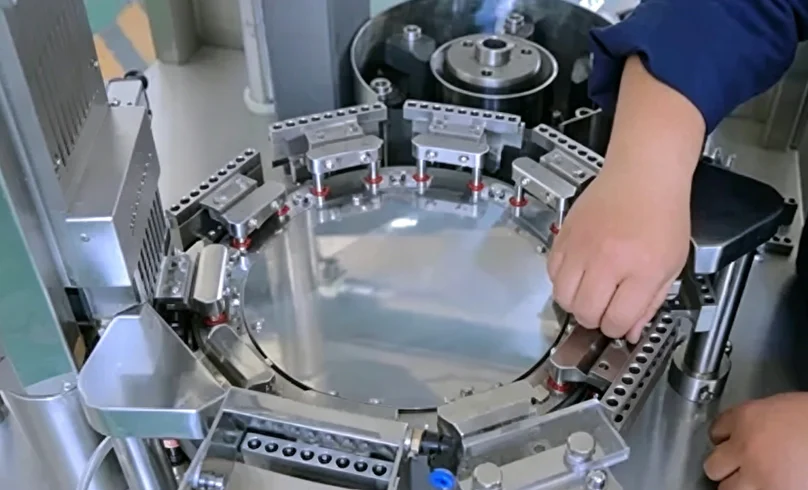
Intermittent machines typically change capsule size in 20–45 minutes; continuous machines take 45–90 minutes. If you run small batches (under 200,000 capsules) with frequent changeovers, the time saved by intermittent motion often outweighs its slower top speed.
Intermittent machines have simpler timing adjustment (one indexing box) and require moderate operator training. Continuous machines have multiple synchronized servo axes and require high operator skill.
Intermittent machines experience lower tooling wear because filling occurs while the turret is stopped. Continuous machines experience higher wear due to constant motion and more friction points.
Profile: 40+ SKUs, many with hygroscopic or cohesive herbal extracts. Batch sizes 50k–150k capsules. Frequent changeovers (6–8 weekly).
Material challenge: Powders that bridge, stick, and vary by batch.
Recommended motion: Intermittent rotary. Adjustable dwell time allows each powder to settle before dosing. Faster changeovers accommodate the high SKU count. Lower operator training requirements suit a mixed-skill workforce.
Decision factor: Material flexibility and changeover speed outweigh maximum output.
Profile: One formulation, well-characterized free-flowing granulation. Batch sizes 1M+ capsules. Rare changeovers.
Material challenge: None—material is consistent and well-behaved.
Recommended motion: Continuous rotary. High sustained output reduces cost per capsule. The complexity is manageable with dedicated technical staff. Material behavior does not limit the machine.
Decision factor: Volume efficiency justifies higher machine complexity.
For production environments needing to match machine architecture to both material and batch size, see how modular configurations are structured in the solutions overview for pharmaceutical manufacturing →.
Reality: Continuous machines can handle difficult powders—but they require tighter control of powder properties. Some continuous designs use augers or forced feeding to handle poor-flow materials. However, if your powder properties vary batch to batch, intermittent motion provides more margin for error.
Reality: Intermittent motion remains the dominant architecture for many pharmaceutical and nutraceutical applications. It is not “outdated”—it is simply optimized for flexibility rather than maximum speed.
Reality: Pellets require appropriate dosing mechanisms, not a specific motion type. Some continuous machines are specifically designed for pellets. Some intermittent machines struggle with pellets. Evaluate the dosing system, not just the motion.
You now understand that the choice between intermittent and continuous rotary capsule filling machines depends primarily on your material characteristics:
Free-flowing powders: Either architecture works—choose based on batch size and changeover needs
Cohesive / poor-flow powders: Intermittent rotary provides adjustable dwell time for consistent dosing
Granules: Either works if granule quality is controlled
Pellets: Evaluate the dosing mechanism, not just motion type
Once you have characterized your primary material and identified which motion architecture suits it, comparing specific machine specifications becomes straightforward. Review how different models implement the filling principle that matches your material—tamping pin for powders, vacuum or gravity for pellets—and how their changeover systems accommodate your batch size distribution.
Single-station vs. double-station capsule fillers: which architecture suits batch sizes under 200k units?
How to calculate true batch cost including changeover and cleaning time
Understanding fill weight RSD: acceptable ranges for powders vs pellets vs granules
Powder flow characterization methods for capsule filling – what to test before choosing a machine

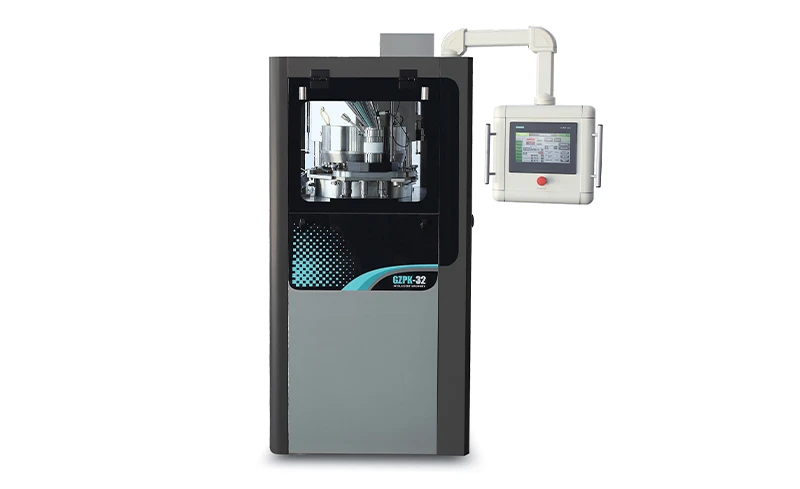
No. of station:26/32/40
Max.tablet diameter:25/16/13mm
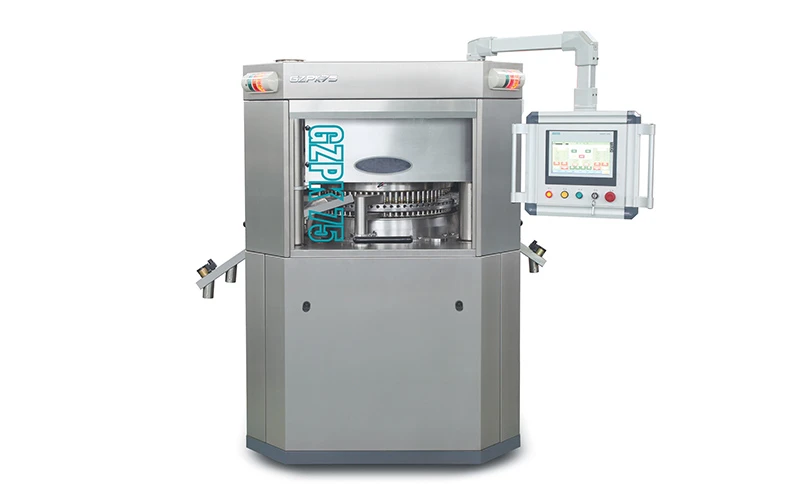
No. of station:45/55/75
Max.tablet diameter:25/16/13mm
24/7 Online Technical Support
One-Year Warranty and Spare Parts Coverage
Lifetime free technical consulting service
GET A QUOTE