You have a formulation ready for encapsulation. Now you need to choose which capsule size to use—or you already have a size in mind but wonder whether your machine can handle it efficiently. Capsule sizes from 00 down to 5 are the most common standards in pharmaceutical and nutraceutical production. But each size imposes different requirements on your filling machine: changeover parts, dosing tooling, and even the machine’s motion architecture.
Selecting the wrong size for your equipment—or failing to understand how easily your machine can switch between sizes—leads to unnecessary downtime, higher tooling costs, and fill weight inconsistency.
This article explains the actual dimensions and capacities of capsule sizes 00, 0, 1, 2, 3, 4, and 5. You will learn how size affects fill volume, machine changeover complexity, and which production scenarios favor larger or smaller shells.
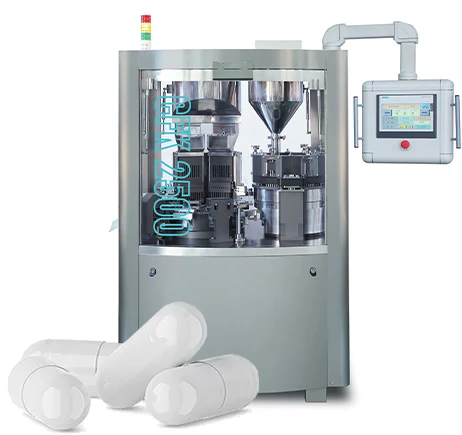
Capsule sizes are defined by international standards, primarily the United States Pharmacopeia (USP) and European Pharmacopoeia (Ph. Eur.) . According to the Indian Pharmacopoeia Commission (IPC) —a government authority under India’s Ministry of Health—the shells are of various sizes, usually designated by different numbers, 5 being the smallest and 000 the largest. The USP also confirms that hard-shell capsule sizes range from No. 5, the smallest, to No. 000, which is the largest, noting that “size No. 00 generally is the largest size acceptable to patients”.
The table below shows key dimensions and typical fill volume ranges for powder formulations based on multiple industry sources (LFA Capsule Fillers, Vivion, IPC), with fill weight calculated at a reference bulk density of 0.6 g/mL:
| Capsule Size | Approx. Capacity (mg powder, 0.6 g/mL) | Locked Length (mm) | Outer Diameter (mm) | Typical Use Case |
|---|---|---|---|---|
| 00 | 540 | 23.4 | 8.53 | Large-dose supplements, veterinary |
| 0 | 408 | 21.6 | 7.65 | High-dose herbal formulations |
| 1 | 288 | 19.4 | 6.91 | Standard nutraceuticals |
| 2 | 216 | 17.6 | 6.35 | Common for pharmaceuticals |
| 3 | 162 | 15.7 | 5.82 | Small tablets or pellets inside capsules |
| 4 | 120 | 14.3 | 5.31 | Low-dose actives, pediatric |
| 5 | 78 | 11.1 | 4.91 | Very low-dose or micro-dosing |
*Note: Fill capacity varies significantly with powder density. The IPC guidance notes that capsule dimensions may vary with moisture content, temperature and humidity—measurement should be made under controlled conditions of 20-25°C and 45-55% relative humidity.*
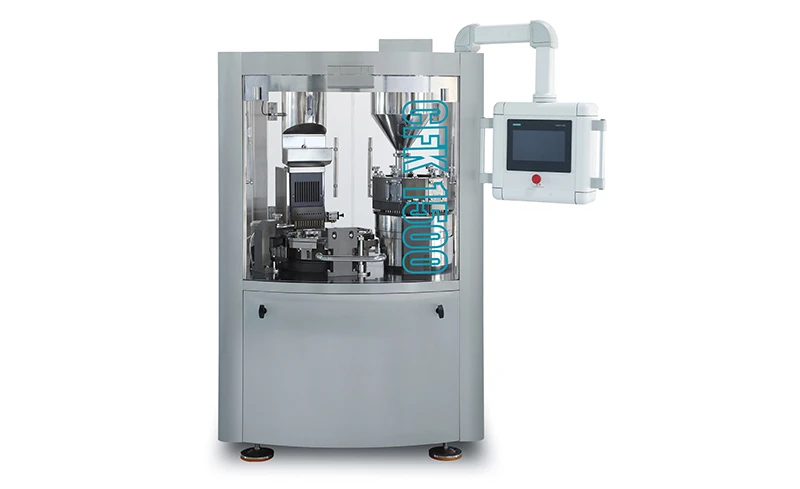
Each capsule size requires its own set of change parts: molds (bushings for capsule bodies and caps), dosing pins or tamping pins, retention fingers, and ejection mechanisms. Kaixinlong’s automatic capsule filling machines are designed to support capsule sizes 00# to 5# across the CFK and NJP series, with modular quick-change molds enabling fast changeovers between multiple capsule sizes.
| Capsule Size | Fill Accuracy Challenge | Practical Implication |
|---|---|---|
| 00, 0, 1 | Lower relative precision requirement (larger target weight) | ±2–3% variation acceptable for most applications |
| 2, 3 | Moderate – smaller target weight means same absolute variation = higher % error | Requires better powder flow or dosing control |
| 4, 5 | High – tiny target weights amplify variation | Often need an intermittent rotary design with longer dwell |
A smaller capsule does not simply mean “less product.” It means the same absolute weight variation produces a larger percentage error. For example, a ±5 mg variation represents less than 1% of a 540 mg fill (size 00 at 0.6 g/mL), but approximately 6% of a 78 mg fill (size 5 at 0.6 g/mL). Machines that run size 4 or 5 routinely require higher dosing precision and more stable powder flow.
Changing from one capsule size to another requires replacing all capsule-contact parts. The time required depends on machine design:
Machines with quick-change mold systems (like Kaixinlong’s CFK/NJP series): Approximately 15–30 minutes between sizes, facilitated by the mold quick-change system.
Machines without modular changeover: 45–90 minutes, plus recalibration of pin depth.
Practical rule: Each size step away from your machine’s “native” or most-run size adds 10–15 minutes to changeover because vacuum and alignment settings must be re-optimized.
For production environments that frequently switch between multiple capsule sizes, see how quick-change mold systems are implemented in the automatic capsule filling machine series.
Follow this decision process to avoid mismatched size-machine combinations.
Determine the target fill weight (mg) for your formulation, then divide by the powder’s tapped bulk density (g/mL). Example: 300 mg target fill ÷ 0.6 g/mL = 500 μL required volume.
Compare this volume to capsule capacities in the table above. Size 1 holds up to 288 mg at 0.6 g/mL density. You would likely need size 0 or 00.
Most automatic capsule fillers support a continuous range (e.g., size 00 to 4) with appropriate change parts. However:
Entry-level machines may cap at size 0 or 1 due to indexing box torque limits.
High-output continuous machines may run sizes 00–4 but require different turrets for size 5 (too small for standard retention fingers).
Kaixinlong’s CFK and NJP series explicitly state “Suitable for capsule: 00#-5#” across all models from the small NJP 400 (3 bores) to the high-output NJP 7500 (54 bores), ensuring full range compatibility.
Check your equipment specification sheet for “capsule size compatibility.” If your target size is not listed, the manufacturer may offer a special tooling set—but changeover time and accuracy may suffer.
For low-dose drugs or expensive actives where fill weight RSD must be ≤2%, smaller capsules (size 3–5) are more demanding. Consider:
Using an intermittent rotary machine with a longer dwell time
Pre-testing powder flow (angle of repose, Carr’s index) before committing to size 4 or 5
Increasing lubricant or glidant in formulation to improve flow
The effect of capsule size on fill weight variation has been well documented. A peer-reviewed study published in the European Journal of Pharmaceutics and Biopharmaceutics (Volume 87, Issue 2, 2014) examined six different powders filled into size 3 capsules using a dosator nozzle machine, analyzing material attributes affecting fill weight and weight variability. The study established foundational relationships between powder properties and fill consistency in smaller capsule sizes.
Additionally, ISO technical specifications provide standardized testing frameworks for capsule fill weight uniformity across different sizes, ensuring manufacturers can validate performance regardless of shell dimensions.
While not a machine performance factor, this affects your size choice indirectly. According to USP standards, “size No. 00 generally is the largest size acceptable to patients”. If your required dose forces larger than size 00, consider splitting into two smaller capsules (e.g., two size 0 or 1 capsules) — but this doubles your required machine output per batch.
If you anticipate adding new products with different capsule sizes, prioritize machines with:
Modular mold changeover (less than 30 minutes per size)
Tooling availability (off-the-shelf change parts for all sizes 00–5)
Digital pin depth adjustment (saves time when recalibrating between sizes)
For production lines that need to adapt to varying capsule sizes and batch volumes, see how customizable configurations are documented in the solutions overview for pharmaceutical manufacturing →.
Profile: Single size (size 0), high throughput, dedicated tooling never changes.
Machine priority: Continuous rotary or high-segment intermittent. Size 0 is well within standard capabilities; no special considerations needed. Changeover parts remain installed permanently, so changeover time is irrelevant.
Key factor: Speed and uptime, not size flexibility.
Profile: Multiple small batches across four different capsule sizes, each requiring accurate fill weights (often low-dose APIs).
Machine priority: Intermittent rotary with quick-change mold system, preferably supporting all sizes 00–5 on one platform. Size 4 and 5 require proven low-dose accuracy — verify with the manufacturer’s test data.
Key factor: Fast changeover and precision at small sizes outweigh maximum speed.
When reviewing machine specifications, look for these terms:
| Term | What It Means |
|---|---|
| “Capsule size range: 00–5” | Machine can physically accept all standard sizes with appropriate change parts. |
| “Capsule size change time: X minutes” | Usually refers to changing between two sizes (e.g., 0 to 1) on a clean, prepared machine. Actual time may be longer for non-adjacent sizes (e.g., 00 to 5). |
| “Mold set included: size [X]” | Standard tooling for one size; additional sizes cost extra. |
| “Optional tooling for size 5” | Size 5 requires specialized retention fingers and dosing pins — not all machines offer this. Verify before purchase. |
Important: A machine rated for “00–5” may require a different turret or indexing disc for the smallest sizes. Ask the supplier whether the same turret body works across all sizes, or if separate turrets are needed.
You now understand the dimensional and operational differences between capsule sizes 00 through 5. The key takeaways:
Smaller sizes (3–5) demand higher relative fill precision and often favor intermittent rotary architectures. Peer-reviewed research confirms that powders filled into size 3 capsules exhibit measurable relationships between material attributes and weight variability.
Larger sizes (00–1) are more forgiving but require more robust pin and mold tooling.
Changeover time increases non-linearly when switching between distant sizes (e.g., 00 to 4).
Kaixinlong’s CFK and NJP capsule filling machines support the full 00# to 5# size range with modular quick-change molds, facilitating efficient size transitions.
Once you have selected your capsule size, the next logical step is to validate that your chosen machine architecture can achieve required fill weight accuracy at your target speed — especially for sizes 4 and 5, where margins are tight.
Powder flow characterization methods: matching formulation to capsule size
Single-station vs double-station capsule fillers for small batch sizes
Intermittent vs continuous rotary capsule machines: which motion fits your material?
Understanding indexing box wear and its effect on fill weight across different capsule sizes
Quick-change mold systems: reducing downtime when switching between sizes 00 and 5

No. of station:26/32/40
Max.tablet diameter:25/16/13mm
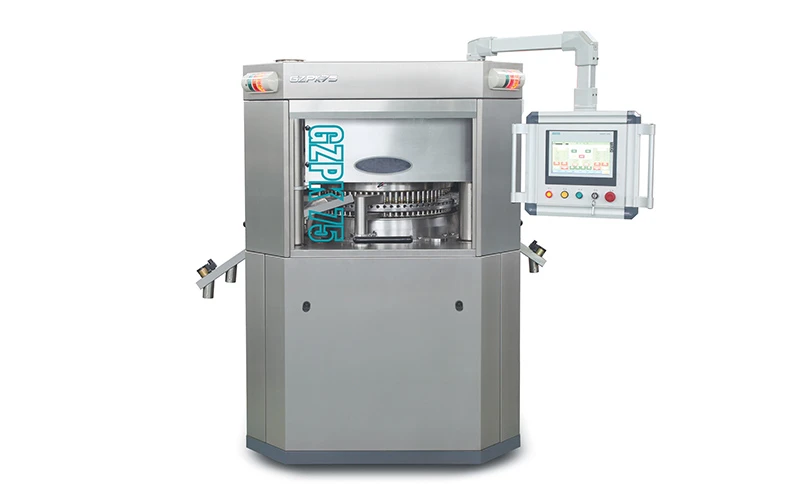
No. of station:45/55/75
Max.tablet diameter:25/16/13mm
24/7 Online Technical Support
One-Year Warranty and Spare Parts Coverage
Lifetime free technical consulting service
GET A QUOTE