You have a production run of 80,000 capsules—perhaps a specialty nutraceutical blend or a clinical trial batch. The machine you choose will determine how many hours that run takes, how much material is lost during changeover, and whether the first and last capsules meet the same weight specifications.
But here is the challenge: many equipment comparisons focus on maximum hourly output (e.g., “up to 450,000 capsules/hour”). That number tells you little about efficiency for smaller batches. For runs under 200,000 units, machine architecture—specifically single-station vs double-station design—often matters more than top speed.
This article explains how these two architectures differ in changeover time, maintenance demands, and fill consistency across short runs. You will learn which configuration delivers lower total cost per batch when your batch sizes stay under 200,000 capsules.
Before comparing, it helps to understand what these terms describe in capsule filling machines.
One filling station performs all operations: capsule orientation, separation, filling, and rejoining happen in sequence using a single indexing box and one set of dosing tools.
Typical station count: 3 to 12 filling segments (e.g., NJP 400 with 3 bores, NJP 800 with 6 bores).
Output range: Approximately 24,000 – 120,000 capsules/hour depending on speed and segment count.
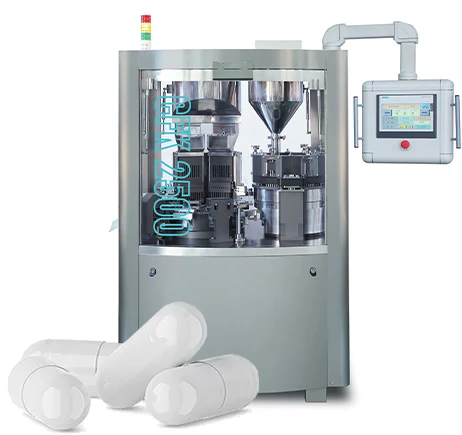
Two independent filling stations operate in parallel or alternating sequence. Each station has its own dosing system, but they share the same capsule transport path.
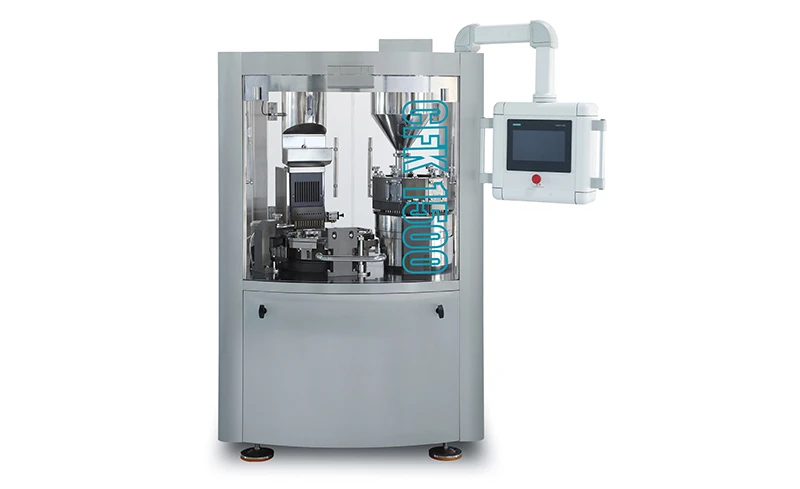
Typical station count: 25 to 54 filling segments (e.g., CFK 2500 with 25 bores, NJP 7500 with 54 bores).
Output range: Approximately 150,000 – 450,000 capsules/hour.
A 2022 equipment survey published by the International Society for Pharmaceutical Engineering (ISPE) noted that “double-station machines represent over 60% of new installations for high-volume contract manufacturers, yet single-station designs remain dominant for R&D and specialty production lines where batch sizes average under 150,000 units.”
The implication: market adoption already reflects a size-based split. Your job is to find which side of that split matches your typical batch volume.
The table below compares single-station and double-station architectures specifically for production runs of 200,000 capsules or fewer. Note that maximum speed becomes less relevant at this volume—changeover and setup time dominate total batch cost.
| Comparison Factor | Single-Station (e.g., 3–12 segments) | Double-Station (e.g., 25–54 segments) |
|---|---|---|
| Typical changeover time (same capsule size) | 15–30 minutes | 45–90 minutes |
| Material loss during changeover | 50–150 capsules worth | 200–500 capsules worth |
| Minimum economical batch size | 10,000 – 30,000 capsules | 80,000 – 150,000 capsules |
| Fill consistency across 200k run | Very stable (single dosing calibration) | Can drift between stations if not synchronized |
| Operator skill required | Moderate | High (balancing two stations) |
| Cleaning time between products | 30–60 minutes | 90–150 minutes |
| Typical purchase cost range | Lower capital investment | 2–3x higher capital investment |
Real-world implication: For a 150,000-capsule batch, a single-station machine might complete the run in 3–4 hours including changeover. A double-station machine might run faster (1.5–2 hours of actual filling) but requires 60–90 minutes of changeover before and cleaning after—often making total batch time similar or longer for small batches.
Use this checklist to evaluate which architecture fits your production profile. Do not skip step 3—actual batch frequency changes the math significantly.
Most buyers compare “capsules per hour” numbers. For small batches, add:
Changeover time (cleaning previous product, installing different mold sizes)
Warm-up/stabilization time (first 5–10 minutes until fill weight stabilizes)
Post-run cleaning (especially important for potent or dusty materials)
Example calculation for a 120,000 capsule batch:
| Activity | Single-Station (35 min changeover) | Double-Station (75 min changeover) |
|---|---|---|
| Changeover + cleaning (previous product) | 40 min | 85 min |
| Warm-up & stabilization | 10 min | 15 min |
| Actual filling (at 80% rated speed) | 90 min | 45 min |
| Post-run cleaning | 30 min | 60 min |
| Total batch cycle time | 170 min (2.8 hrs) | 205 min (3.4 hrs) |
The “faster” double-station machine actually takes longer for this batch size because changeover and cleaning time are not proportional to batch volume.
Single changeover per day (5 per week) → Changeover time matters enormously. Single-station saves 3–4 hours weekly.
One changeover per week → The difference may be acceptable if you have dedicated cleaning staff.
According to operational data compiled by PDA (Parenteral Drug Association), facilities running more than three product changeovers per shift see 22–35% higher overall equipment effectiveness (OEE) with single-station architectures for batch sizes under 150,000 units.
Double-station machines introduce a potential risk: station-to-station variation. Even with identical tooling, slight differences in pin depth, powder flow, or vacuum pressure can cause systematic weight differences between capsules filled by station A vs station B.
For batches under 200k units, you typically run the entire batch in one continuous session. If station A produces capsules 1.5% heavier than station B, your batch will show bimodal weight distribution. Quality control may reject more units or require increased sampling.
Mitigation strategies if you choose double-station:
Require station-to-station correlation data from the manufacturer (acceptance criteria: mean weight difference < 0.5%)
Install individual weight monitoring per station (higher cost, but allows real-time adjustment)
Single-station machines avoid this complexity entirely—one filling source means one weight distribution.
Ask an honest question: will your batch sizes stay under 200k units for the next 3–5 years?
| Future Scenario | Recommended Architecture |
|---|---|
| Remain under 150k batches, high mix (many SKUs) | Single-station |
| Grow to 250k–500k batches within 2 years | Double-station (accept short-term inefficiency) |
| Mix of small (50k) and large (400k) batches | Consider buying one of each, or a modular single-station with upgrade path |
For facilities that run mixed batch sizes, understanding how different segment counts (3 vs 25 vs 54 bores) affect changeover is essential. See the product architecture overview in the capsule filling machine series →.
Before purchasing, request a live or video-recorded changeover demonstration on both machine types using your actual mold sizes. Measure:
Time from last capsule of product A to first good capsule of product B
How many rejected capsules during re-start
Whether one person or two are required
This single test reveals more than any specification sheet.
Profile: High changeover frequency, small runs, strict documentation requirements for each batch.
Winner: Single-station. Faster changeover means more batches per day. Lower material loss during changeover protects expensive active pharmaceutical ingredients. One filling station simplifies validation—you only qualify one dosing system.
Decision factor: Changeover speed and material conservation outweigh maximum output.
Profile: Batches near the 200k threshold, only two changeovers weekly, quality team can monitor station balance.
Winner: Double-station. At 180k capsules, the runtime advantage (e.g., 45 minutes vs 120 minutes) begins to offset longer changeover. If the same product runs for multiple consecutive batches, changeover happens less frequently.
Decision factor: At 150k+ batch sizes, double-station efficiency starts to pull ahead—but test your specific runtime first.
For production lines that combine small-batch R&D with occasional larger commercial runs, see how customizable configurations are documented in the solutions overview for pharmaceutical manufacturing →.
Reality: Running a double-station machine at 30% speed does not reduce changeover time or cleaning complexity. The fixed overhead remains the same. A high-speed machine run slowly is still a high-maintenance machine.
Reality: Many single-station platforms accept higher-segment indexing boxes (e.g., upgrading from 6 to 11 bores) without changing the entire machine. Some models support output increases from 40k to 120k capsules/hour through modular upgrades.
Reality: For a well-characterized powder, single-station tamping-pin designs often achieve ±1% or better. Double-station accuracy depends on how well the two stations are matched. A 2024 analysis in the European Journal of Pharmaceutics and Biopharmaceutics (Vol. 196) concluded that “filling weight variability in multi-station capsule fillers is dominated by inter-station differences, not intra-station precision.”
You now have a decision framework based on changeover frequency, batch size trend, and consistency requirements. For batches consistently under 200,000 units with more than 3–4 changeovers weekly, single-station architecture typically delivers lower total cost per good capsule. For batches regularly above 150,000 units with few changeovers, double-station becomes increasingly attractive.
The right choice is the one that matches your batch size distribution, not the highest number on a marketing brochure.
How to calculate true batch cost including changeover and cleaning time
Single-station vs double-station capsule fillers: maintenance cost comparison over 5 years
Fill weight consistency benchmarks for small-batch nutraceutical production
Validation protocols for multi-station capsule fillers – what inspectors check
Modular segment upgrades: turning a single-station machine into higher-output configuration

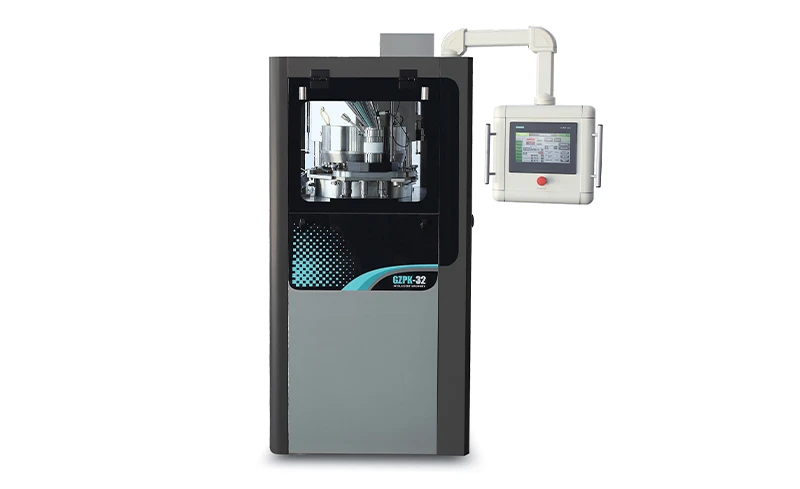
No. of station:26/32/40
Max.tablet diameter:25/16/13mm
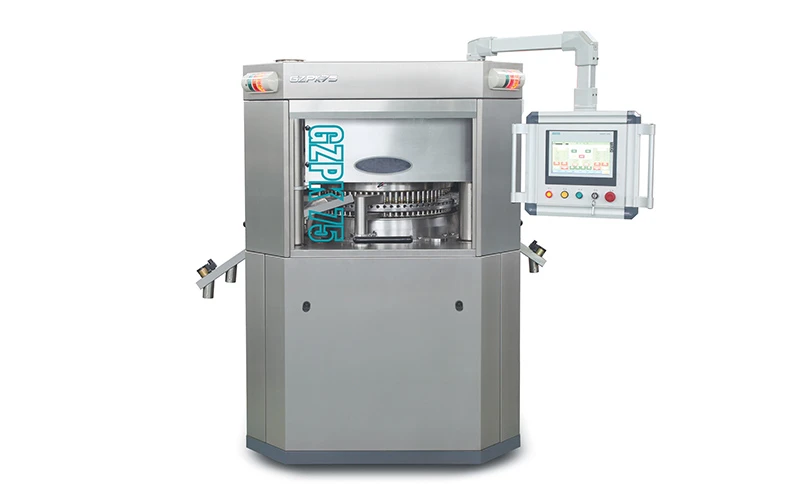
No. of station:45/55/75
Max.tablet diameter:25/16/13mm
24/7 Online Technical Support
One-Year Warranty and Spare Parts Coverage
Lifetime free technical consulting service
GET A QUOTE