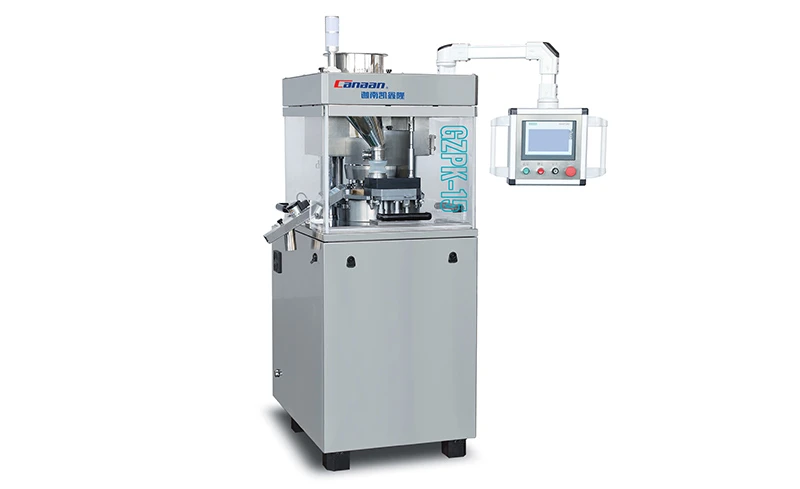
You are evaluating capsule filling equipment and encounter two descriptions that sound similar but behave very differently: “intermittent rotary” and “continuous rotary.” Both machines rotate. Both fill capsules. Yet the way each moves—stopping and starting versus flowing without pause—affects fill accuracy, tooling longevity, changeover complexity, and even which powder types run successfully.
Choosing between these two motion architectures without understanding their practical trade-offs can lead to production inefficiencies that only surface months after installation.
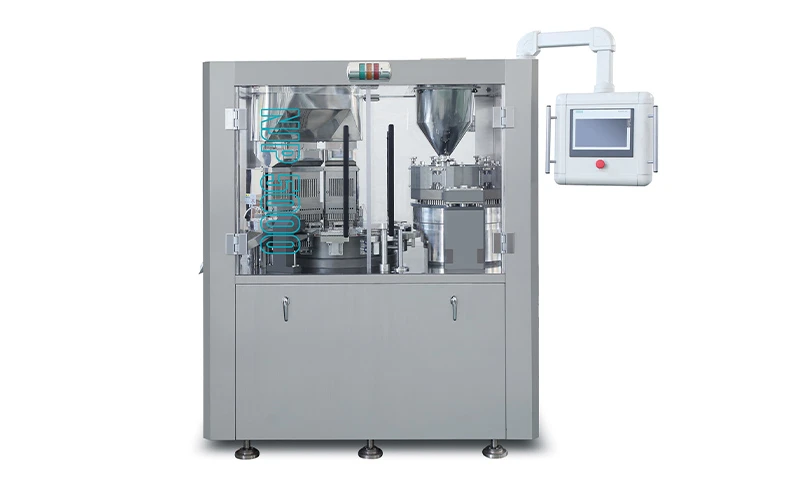
This article explains how intermittent and continuous rotary systems actually work, what each motion type means for fill weight consistency, and which production profiles favor one architecture over the other.
The terms refer to how the capsule transport system—typically a rotary turret or segmented wheel—moves during the filling cycle.
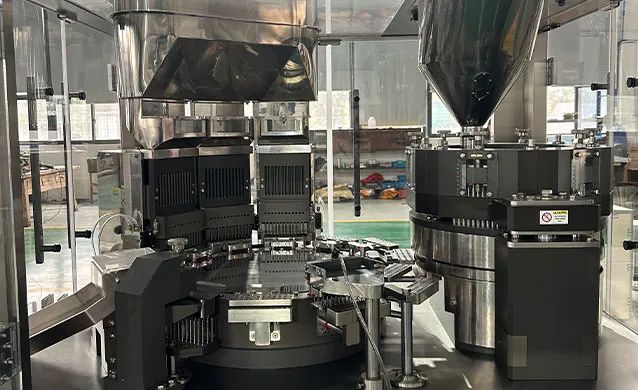
The turret rotates in discrete steps. At each stop, multiple operations occur simultaneously: capsules are fed, separated into bodies and caps, filled, rejoined, and ejected. The turret remains stationary during filling, then rotates to the next position, stops again, and repeats.
Typical segment count: 3 to 54 filling positions, depending on machine size.
Motion pattern: Move → stop → fill → move → stop → fill
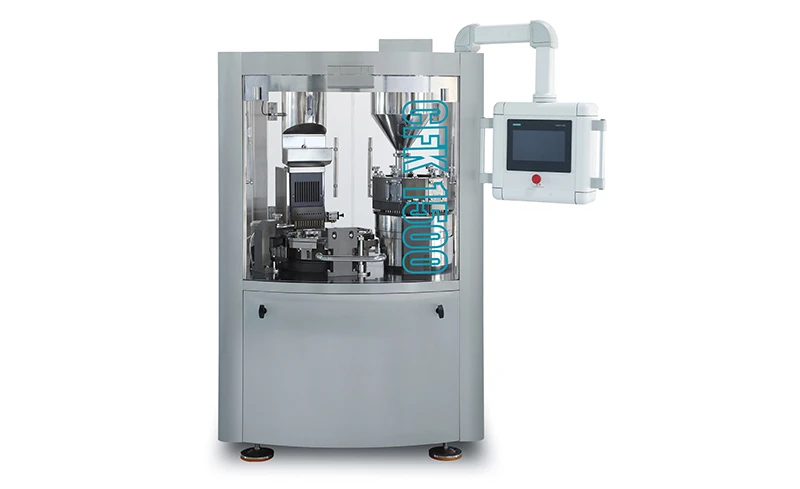
Common in: Traditional capsule fillers, including many NJP and CFK series machines.
The turret rotates without stopping. Capsules move through a circular path while filling occurs during motion. Dosing systems (tamping pins or vacuum cups) are synchronized to move with the turret during the fill phase, then retract and reset.
Motion pattern: Continuous rotation, filling components moving in sync during the fill zone
Common in: High-output modern capsule fillers, often rated for 200,000+ capsules/hour.
A technical reference from the American Association of Pharmaceutical Scientists (AAPS) notes that “the transition from intermittent to continuous rotary designs in capsule filling has been driven primarily by speed demands, though each architecture presents distinct advantages in fill accuracy mechanics at lower speeds.”
The table below compares key operational characteristics. Note that neither architecture is universally superior—the best choice depends on your batch sizes, powder characteristics, and maintenance resources.
| Comparison Factor | Intermittent Rotary | Continuous Rotary |
|---|---|---|
| Typical speed range | 24,000 – 150,000 capsules/hour | 120,000 – 450,000+ capsules/hour |
| Fill accuracy potential | Very high (±1-2% typical) | High (±2-3% typical at high speed) |
| Dwell time for filling | Fixed stop duration (adjustable) | Limited by rotational speed |
| Tooling wear rate | Lower (stopped during filling) | Higher (constant motion, more friction points) |
| Complexity of timing adjustments | Moderate (one indexing box) | High (multiple synchronized servo axes) |
| Time to change capsule size | 20-45 minutes typical | 45-90 minutes typical |
| Operator training required | Moderate | High (understanding servo timing) |
| Typical capital cost range | Lower to moderate | Higher (more servo motors, complex controls) |
Real-world implication: For a powder with poor flow characteristics that requires longer dwell time for consistent dosing, an intermittent machine allows you to pause longer at the fill station. A continuous machine forces filling to complete within a fixed angular window—no matter how the powder behaves.
Use this decision framework. Factor 1 (powder behavior) and Factor 4 (changeover frequency) often determine the correct choice more than speed alone.
Intermittent rotary advantage: The filling station sees a stationary, stopped turret. Dosing pins or tamping pins can dwell inside the powder bed for a controlled duration. For cohesive powders, hygroscopic materials, or blends with wide particle size distribution, longer dwell improves fill consistency.
Continuous rotary limitation: The fill window is fixed by turret rotation speed. At 200,000 capsules/hour, the available fill time per capsule may be only 50-100 milliseconds. Powders that require any “settling” or compression time will show higher weight variation.
Guideline: If your powder has a Carr’s index above 25% or Hausner ratio above 1.25 (indicating poor flow), intermittent motion typically delivers more consistent fill weights.
Continuous rotary shines when your routine batch sizes exceed 300,000 capsules and you run the same product for multiple shifts. The higher sustained speed reduces labor cost per thousand capsules.
Intermittent rotary is sufficient for batch sizes under 200,000 capsules. The time lost to indexing stops becomes negligible compared to changeover and cleaning time.
| Annual production volume | Suggested motion architecture |
|---|---|
| Under 15 million capsules | Intermittent (sufficient capacity, lower complexity) |
| 15-40 million capsules | Either (depends on changeover frequency) |
| Over 40 million capsules | Continuous (speed advantage justifies complexity) |
Continuous rotary machines contain more servo motors, cam followers, and synchronized moving components. Troubleshooting fill weight drift requires understanding timing relationships between turret position and dosing pin motion.
Intermittent machines use a single indexing box as the master timing component. When fill weights drift, the diagnostic path is shorter: check indexing box precision, pin depth, powder level.
Internal link suggestion (product architecture): For facilities prioritizing simpler maintenance and faster troubleshooting, see how intermittent rotary designs are implemented in the capsule filling machine series →.
Each changeover on a continuous rotary machine typically requires re-synchronizing multiple axes: dosing pin vertical position, vacuum timing, and ejection position. Some continuous machines use software-based adjustment (easier), but the physical setup remains more involved.
Intermittent machines have mechanical stops and fixed cam profiles. Changeover primarily involves swapping molds and adjusting pin depth—tasks that operators learn quickly.
Guideline: If you perform more than 3-4 changeovers per week, intermittent rotary architecture usually yields lower total changeover time per week despite slower running speed.
For products requiring ±1% fill weight tolerance (e.g., potent APIs, expensive nutraceuticals), intermittent machines offer a fundamental advantage: the filling tool contacts a stationary capsule body. No relative motion exists during the fill stroke.
Continuous machines must synchronize moving filling tools with moving capsules. Any synchronization error (even 0.5 mm misalignment) creates fill weight bias that varies with machine speed.
Research published in the International Journal of Pharmaceutics (Vol. 620, 2022) examined fill weight variation sources across 12 capsule filler architectures and concluded: “Stationary-turret filling (intermittent design) consistently produced lower RSD values than continuous-motion designs when tested with powders exhibiting angle of repose above 40 degrees.”
Profile: High mix, low to medium volume per batch, powders vary significantly (free-flowing protein blends to cohesive herbal extracts).
Winner: Intermittent rotary – Faster changeovers accommodate high mix. Longer available fill dwell handles difficult powders. Simpler maintenance means less downtime when switching between very different materials.
Decision factor: Flexibility and changeover speed outweigh maximum output.
Profile: High volume, low mix, consistent powder properties, technical staff available for complex troubleshooting.
Winner: Continuous rotary – Higher sustained output reduces cost per thousand capsules. The speed advantage fully utilized. Complexity is manageable with dedicated technical team.
Decision factor: Volume efficiency justifies higher machine complexity.
Internal link suggestion (application fit): For production environments that require high flexibility across changing batch sizes, see how modular architectures are structured in the solutions overview for pharmaceutical manufacturing →.
Reality: Continuous motion is newer and faster, but “advanced” does not mean “better for your application.” Many experienced production managers prefer intermittent designs for R&D lines, clinical trial manufacturing, and high-mix nutraceutical facilities because the technology is proven, predictable, and easier to troubleshoot.
Reality: High-end intermittent rotary machines reach 150,000+ capsules/hour—sufficient for the majority of pharmaceutical and supplement manufacturers. Only the largest contract manufacturers routinely need speeds above 200,000 capsules/hour.
Reality: The opposite is often true for challenging powders. Intermittent designs allow controlled fill dwell time. Continuous designs compress fill time as speed increases, which can amplify weight variation with difficult materials.
You now understand the core difference: intermittent machines stop for filling (allowing longer, controlled dwell), while continuous machines fill during motion (prioritizing speed over fill time flexibility).
For high-mix, lower-volume production with challenging powders, intermittent rotary architecture typically delivers better fill accuracy and lower changeover burden. For dedicated, high-volume lines running the same product for days, continuous rotary offers efficiency advantages.
The correct choice aligns with your powder characteristics and batch size distribution—not marketing claims about which technology is “newer.”
How to validate fill weight accuracy during capsule machine commissioning
Powder flow characterization methods for capsule filling
Understanding indexing box wear patterns and their effect on fill weight RSD
Changeover time reduction strategies for intermittent rotary capsule fillers

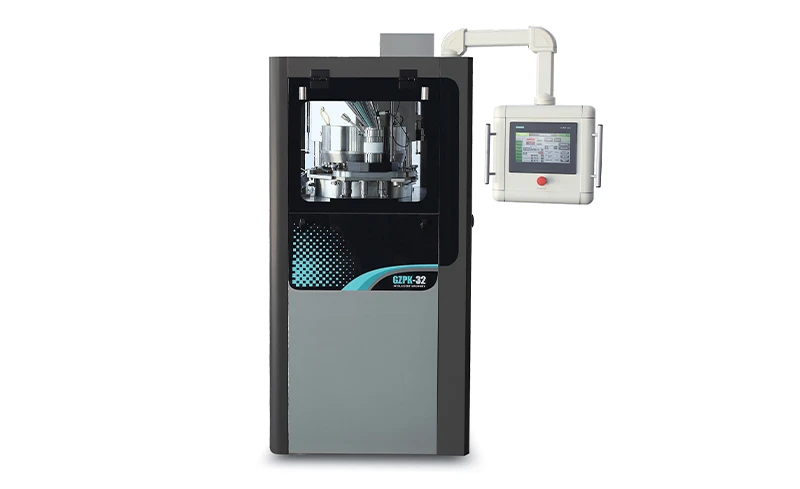
No. of station:26/32/40
Max.tablet diameter:25/16/13mm
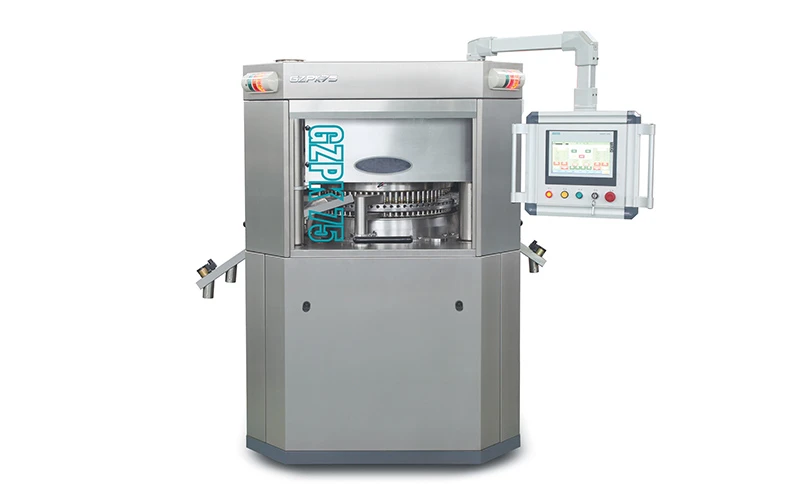
No. of station:45/55/75
Max.tablet diameter:25/16/13mm
24/7 Online Technical Support
One-Year Warranty and Spare Parts Coverage
Lifetime free technical consulting service
GET A QUOTE